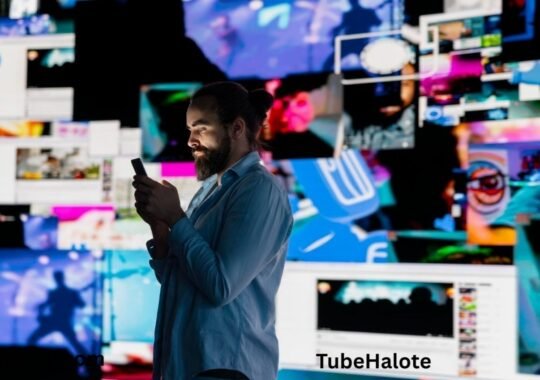

Beyond 2025, smartphones will no longer dominate personal computing. Tech giants are betting more than $150 billion on augmented reality (AR) glasses, AI-based companions, brain-computer interfaces (BCI), and ambient computing ecosystems, all of which are things that no one has ever done before. They see a future beyond smartphones. The goal of these technologies is to let users break free from the screen and give customers a better and more useful way to participate in everyday life.
The sector estimates a $3 trillion opportunity in post-smartphone technology, even if the smartphone sector grew 6.4% in 2024. This is because AI and AR can do several things at once and AR can show things visually. This blog looks at the investments, new ideas, problems, and ambitions that are driving this change. It shows how tech giants see a future beyond smartphones.
Main Points
- Tech titans are putting more than $150 billion into AR, AI, BCI, and ambient computing technologies because they see a future beyond smartphones.
- The smartphone industry is becoming saturated, which is increasing the need for hands-free, privacy-focused solutions that meet customer expectations.
- Meta, Neuralink, OpenAI, Google, and Apple are some of the big companies working on new technologies that could replace or improve cellphones.
- For these new technologies to be widely used, problems like privacy, ethics, and battery life need to be solved.
- The $3 trillion market opportunity shows how important the economy is and how it could affect global GDP as technologies get better.
The Shift to a Post-Smartphone Era: Tech giants see a future beyond smartphones.
The smartphone market is growing up, and by 2027–2028, people are predicted to use them less. Tech companies are putting more than $150 billion into things like AR glasses and AI-driven systems that go beyond smartphones. This move is meant to generate “ambient intelligence” by 2032 to 2035, which would let devices anticipate needs without being told to. This could make smartphones useless. The worldwide AI market will also be valued $243.7 billion by 2025, expanding 27.67% every year. The AR/VR markets are also growing quickly for business use. Also, the Fortune 500 organizations that use AI tools are seeing revenue growth of 6% to 10% quite quickly.
Some of the main reasons for this change are:
- Market Saturation: In 2024, financing for smartphone accessories dropped by 23%, which means that investors were no longer interested in traditional mobile technology.
- Technological Advances: Wearables and implantable devices will be able to do more and better than smartphones because of improvements in AI, sensors, and downsizing.
- Consumer Demand: Surveys show that 68% of users prefer hands-free technology that lets them do multiple things at once and individualized interfaces that protect their privacy.
- Economic Incentives: By 2030, the market for smartphones is expected to grow from small, specialized areas to a $3 trillion mega-industry. This makes it a good venue for research and development.
Timeline for Disruption - 2025–2026: Early adoption with things like cheap AR glasses and the development of active brain interfaces into products.
- 2027–2028: The general public starts using AR, it reaches smartphone-like intelligence levels in professional fields, and ambient AI reaches 25% of all developed markets.
- 2030–2031: 200 million people will employ post-smartphone technology before smartphones become a thing of the past.
Important Players and Their Plans
1. Meta’s Goals for AR and AI
Meta has spent more than $50 billion on its augmented reality and virtual reality divisions since 2019. The Hypernova smart glasses with AR features and holographic displays will come out in 2025, especially after the Ray-Ban Meta glasses sold over a million units last year. Meta also put $3.5 billion into EssilorLuxottica, which owns Ray-Ban and Oakley. This seems like an attempt to make fashionable, AI-powered clothing.
- Key Features: Live AI will help you understand what’s going on around you, and some cameras will let you communicate with other people in real time, adding to Meta’s ecosystem.
- Problems: High production costs (up to $10,000 for each prototype) and short battery life.
- Impact: Meta wants to make AR glasses as popular as smartphones, and they think that 13 million units will be sold around the world by 2030.
2. Neuralink’s Method: Direct Links Between the Brain and Digital
Elon Musk started Neuralink to build brain-computer interfaces (BCIs) that would link enlightenment with AI. The N1 Implant has 1024 electrodes and can give its first patients 99.2% thought-controlled computing. They want to do the second batch of 27 implants in 2025, after promising to map memory improvement by 2026 and sensory inputs by 2027. The $1.8 billion investment by BCI in 2024, which is a 156% rise from the previous year, indicates how IT companies see their future beyond smartphones.
- Uses: Allowing people who are paralyzed to use technology, with the possibility of enhancing their cognitive abilities.
- Market Growth: The BCI market will grow from $2.3 billion in 2024 to $24.7 billion by 2030, including $1.8 billion in VC in 2024 (a 156% growth).
- Competitors: Startups like Synchron, which has raised $75 million, offer stent-based interfaces that are less intrusive.
3. OpenAI’s Model: Putting AI in Everything
OpenAI is working toward ambient intelligence, which is when AI is a part of our surroundings. The idea is to let guessing and contextual AI help us. They estimate to have spent $3.4 billion (up 89%), and 40% of that will go to hardware partnerships that focus on ambient systems. Figure AI is driving robotics and models like o1 and Operator to do jobs on their own.
Innovations in Ambient AI
- Prototypes: Depending on the kind of data users give, AI sensors may change the layout of a room or speed up the procedure.
- Market expansion: By 2030, the global market for integrative hypothetical future technologies is estimated to be worth $156.8 billion, thanks to the expected expansion of mature IoT integrations.
- Problems include the risks of surveillance and corporate data ownership, but tech titans see a future beyond smartphones with interactions that don’t require any learning.
4. Google’s AR ecosystem with AI built in
Google is using AI and AR to make the internet more open, just like Android is the most popular operating system for smartphones. The business has said that it has spent $5.7 billion on research and development for AR and AI. Working with Samsung and Qualcomm to create Android XR, a platform that makes Android work better with extended reality devices. Acquisitions like North (the maker of smart eyewear) strengthen its focus on businesses and show how digital titans see the future beyond smartphones.
Key parts of Google’s plan
Project Astra is an AI tool for AR glasses that can understand its environment through voice and gestures.
- Smart Glasses Development: Smart glasses now use artificial intelligence for real-time translation and navigation, building on what Google Glass taught them. These glasses are aimed at both businesses and consumers.
- Broader Emerging Tech: Investing in edge AI and quantum computing improves ambient computing, which is when smart house hubs and other gadgets can guess what users need.
- Future Outlook: Google’s open source model could help people adopt the technology faster, even while competition from closed ecosystems like Apple’s is a worry.
5. The Spatial Computing Revolution from Apple
Apple is adding spatial computing to its environment instead of giving up on smartphones completely. Tim Cook, the CEO, thinks that AR glasses will eventually take the place of the iPhone. That’s why he spends about 60% of his time on AR initiatives. The corporation also reportedly put over $8.3 billion into research and development for spatial technology. Its main purpose is to find ways to make existing devices work together without problems.
New Ideas and a Plan
- The Vision Pro Headset is a mixed-reality device that costs $3,499 and is the first to use spatial computing, however it has some problems that make it hard to use. About 45% of the people who took part said their eyes hurt, and only 12% said they used it every day after the first enthusiasm wore off.
- Apple Glass: These lightweight AR glasses are rumored to come out in 2026 or 2027. They will show information like instructions and notifications right in the user’s line of sight. They should be able to use the processing power of the iPhone to run smoothly.
- Apple’s strength is in user lock-in because AR glasses work perfectly with Macs, Watches, and iPhones. This integration makes people more productive by adding things like virtual meetings and enhanced purchases.
- Strategic Partnerships: Apple’s significant commitment to AR research is shown by its partnerships with suppliers for superior displays and AI technology. But the hefty pricing and problems with battery life could slow down widespread use.
6. Microsoft’s push toward holographic and mixed reality
Microsoft is looking on holographic interfaces and mixed reality. They are spending $3.2 billion on research and development for technology that lets people interact in mid-air without wearing anything. Its business solutions, like HoloLens, are less focused on consumers, but they are paving the way for AR to be used in industry as tech titans think about a future beyond smartphones.
Main Changes
- HoloLens Series: Getting better for training and design, including AI improvements for recognizing objects.
- Azure Integration: Cloud-based AI helps smart workplaces and industries use ambient computing.
- Partnerships: Working with hardware vendors to build MR devices that can grow.
- Breakthrough technologies that are making the change possible
Prototypes from 2025 show how solutions in graphics, processing, and energy are getting better, making it possible to find other options. Tech titans see a future beyond smartphones.
New ideas for display systems
- Waveguide Tech: Meta’s partnerships will lead to lightweight, clear projections with fields of view that grow to 40 degrees by 2026.
- Retinal Solutions: Mojo Vision’s contact lenses make great pictures quickly and easily.
- Holographic Prospects: Microsoft’s test displays in the air suggest that people will be able to engage without devices in the future.
Finding a balance between local and cloud processing
- On-Device AI: Qualcomm’s XR2+ can do real-time tasks on its own.
- Specialized Chips: Apple’s M4 and Google’s Tensor make AI tasks ten times more efficient.
- Hybrid Models: Meta’s dynamic allocation between phones, glasses, and servers makes performance better.
Improvements in Power Sustainability
- Next-Gen Batteries: Solid-state batteries charge quickly and have three times the density.
- Body and ambient energy sources make it possible for the essentials to run all the time.
- WiTricity’s technology offers continuous power for wearables in wireless systems.
- Problems and insights from consumers throughout the transition
Even if they’re excited, tech companies have a lot of problems to deal with as they think about a future beyond smartphones. Privacy issues are a problem for 74% of brain interface users and 68% of ambient AI users. Battery longevity (89% demand) and integration (67%) are the most important things.
Main Problems and How to Fix Them
- Privacy and Ethics: Keeping an eye on things all the time increases the chance of data loss; one way to fix this is to have open governance.
- Social Friction: 34% of respondents say they don’t like using AR glasses; design tweaks try to make them more normal.
- Implementation Timeline: It will take about 12 to 18 months to experience the benefits of enterprise AI, much like with consumer technologies.
- Cybersecurity: 89% of breaches get around tools, thus strong integration is a must.
Surveys of 12,000 consumers show that reliable, user-centered designs are needed to get people to utilize new technologies. This is in line with how tech titans see the future beyond smartphones.
Final Thoughts
Big tech companies’ investments show a big change is coming, with AR glasses, AI, and other technologies making experiences that don’t need screens and improve human abilities. To make sure that everyone can use it fairly, we need to deal with issues like privacy, ethics, and energy needs. As these technologies get better, they will make powerful computers more accessible to everyone, which will encourage innovation in many fields. In the end, the tech giants see a future beyond smartphones where devices would work together instead of being separate.
The $3 trillion market opportunity shows how important the economy is going forward. It is thought that AI alone would add trillions to the world’s GDP. If big corporations like Microsoft and OpenAI worked together, it would speed up adoption beyond businesses. There are still problems to solve, but the path points to a cybernetic evolution that will make experiences and output better. If this bold vision comes true, it will provide future generations new ways to be creative, much like tech companies see a future beyond smartphones.
Questions and Answers
What are AR glasses, and how are big tech companies putting money into them?
Digital information is superimposed on the real world with AR glasses. Meta is putting $16.1 billion into goods like Ray-Ban Meta and Hypernova. Apple is looking into how to connect with Vision Pro. Both companies see a future beyond smartphones.
What will AI do to the future after smartphones?
AI makes it possible to automate and use ambient computing. Microsoft Copilot increases efficiency in businesses by 67%, and OpenAI works on adding intelligence to settings.
What part do wearables play in technology after smartphones?
Wearables like Apple’s Smart Ring can monitor your health and let you control things with gestures. They also add AI to ecosystems to give you predictive insights.
What are brain-computer interfaces, and who is in charge of them?
BCIs let you control things with your mind. Neuralink’s N1 implant is in the lead with studies and hopes to be widely used by 2030, with $1.8 billion in industry investments.
When will AR glasses be common?
Smart glasses shipments are expected to reach 87 million by 2028, with releases including Meta’s Hypernova in 2025 and Apple’s in 2026-2027.