
Key Takeaways
- Reliable assembly begins with clear product and process requirements.
- Design decisions affect labor, inspection, packaging, validation, and scalability.
- Quality controls should detect risks at the point where they can occur.
- Automation should address a specific production need, not simply add complexity.
- Packaging, sterilization, traceability, and change control belong in the production plan from the beginning.
Table of Contents
- Why Assembly Planning Matters
- Start With Product Requirements
- Design for Assembly and Inspection
- Choose the Right Assembly Process
- Build Quality Into the Line
- Plan Packaging and Sterilization Early
- Use Data and Automation Wisely
- Manage Validation and Change Control
- Prepare for Production Scale
- Questions to Ask Before Production
Medical device assembly is not simply the act of joining components. It is the controlled process of turning approved materials and parts into a device that performs consistently, can be inspected effectively, and reaches users in its intended condition. Whether a team works internally or evaluates medical device assembly companies, the most important decisions are usually made long before the first production unit is built.
A practical assembly strategy connects product design, material handling, operator training, equipment, testing, packaging, and documentation. When those areas are planned separately, late changes can increase cost and delay a launch. When they are planned together, teams can reduce avoidable variation while keeping the process flexible enough for early production learning.
1. Why Assembly Planning Matters
Assembly choices affect quality, throughput, labor requirements, and the evidence available to support release decisions. Consider a wearable device containing a sensor, battery, adhesive, flexible circuit, enclosure, and label. A minor change to adhesive location may alter fixture design, curing time, inspection access, packaging clearance, and functional test results. Clear work instructions, sensible part presentation, and early process reviews prevent those decisions from becoming costly surprises.
2. Start With Product Requirements
Before selecting equipment or drafting detailed instructions, define what the finished device must do and what conditions the process must maintain. Identify critical dimensions, functional outputs, safety-related features, material compatibility, cleanliness needs, environmental limits, and allowable variation. Separate true requirements from preferences. A preferred cosmetic appearance may matter, but a seal strength or electrical connection requirement may be critical to performance.
A useful checklist asks: What can cause harm or loss of function? Which characteristics must be measured? What evidence is needed to accept the unit? What handling conditions could damage the product? Clear answers make process development, testing, and validation more efficient.
3. Design for Assembly and Inspection
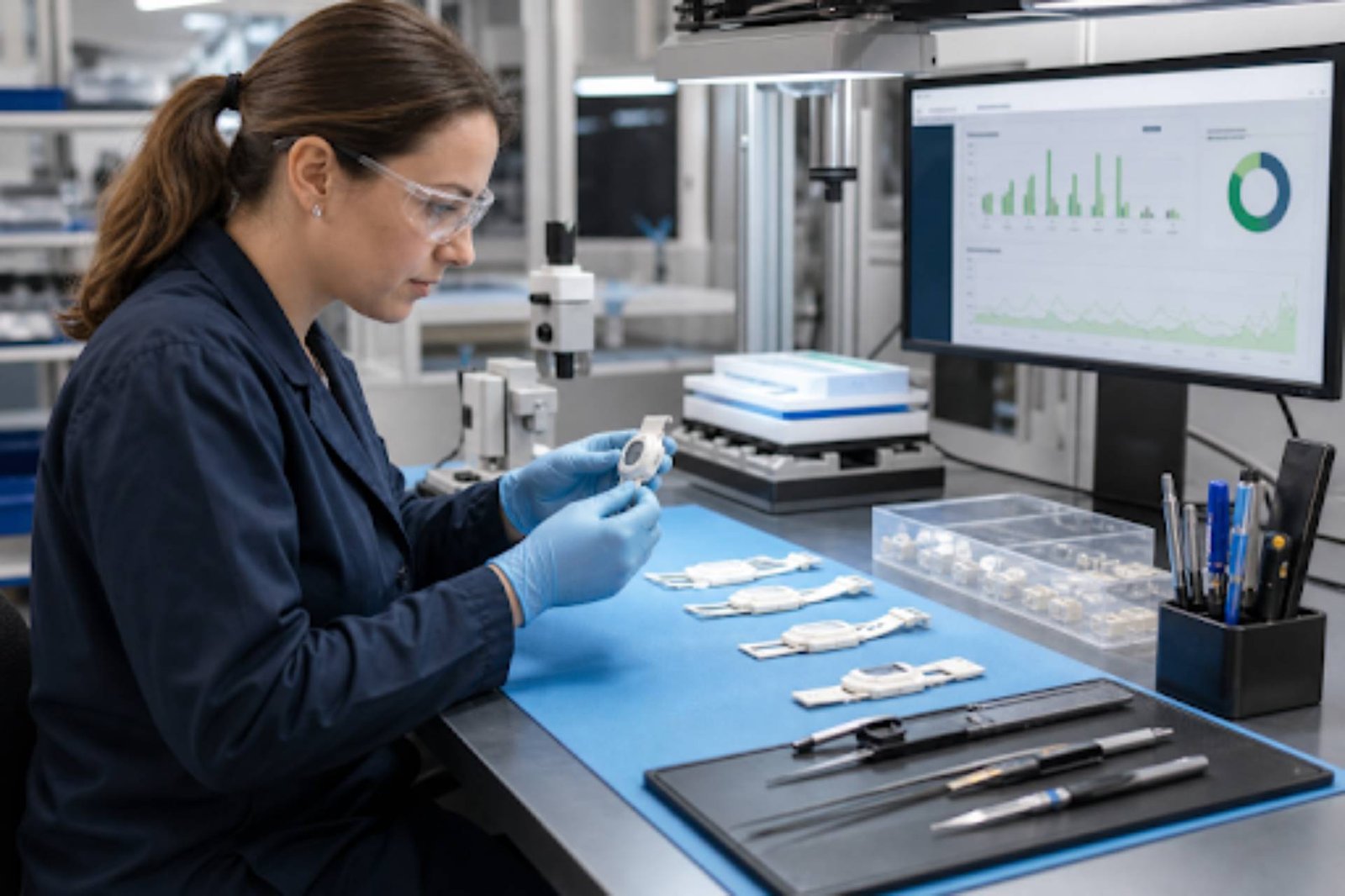
Good design reduces unnecessary part count and minimizes opportunities for incorrect assembly. Use features that guide orientation, distinguish similar parts, and give operators or tools adequate access to joining points. Avoid geometries that require excessive force, awkward handling, or subjective visual judgment. Build inspection into the design by ensuring important features can be observed, measured, or functionally verified.
- Map every assembly step and material handoff.
- Flag steps that depend heavily on individual operator judgment.
- Identify where a tool, fixture, or operator could damage a component.
- Choose a verification method for every critical feature.
- Update the design or process before formal validation begins.
4. Choose the Right Assembly Process
Manual Assembly
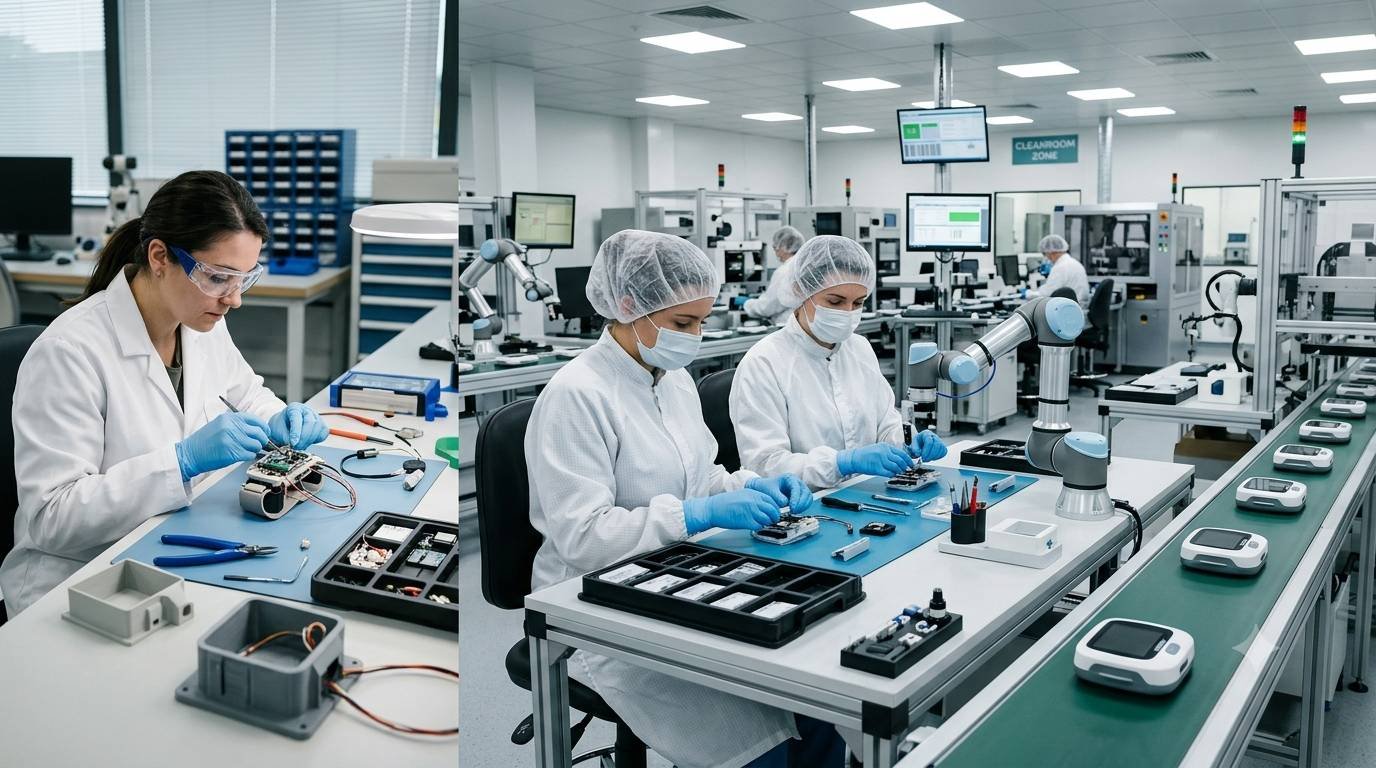
Manual work is often appropriate for prototypes, low-volume products, and delicate tasks requiring judgment. It offers flexibility during design changes, but requires effective training, ergonomic stations, fixtures, and clear acceptance criteria.
Semi-Automated Assembly
Semi-automation combines human judgment with repeatable machine actions, such as controlled dispensing, pressing, curing, marking, or testing. It can reduce variation without the investment and rigidity of a fully automated line.
Automated Assembly
Automation is most effective when volumes are high and part geometry, tolerances, and material inputs are stable. It requires planning for tooling, software, maintenance, spare parts, data collection, and validation. The right choice depends on expected volume, product variety, process stability, inspection needs, labor availability, and product life cycle.
5. Build Quality Into the Line
Final inspection cannot reliably recover defects that should have been prevented or detected earlier. Use incoming checks for critical components, then place controls after high-risk steps such as bonding, welding, soldering, sealing, or calibration. Verify presence, orientation, position, torque, dimensions, or function as appropriate. Define how nonconforming material is identified, segregated, investigated, reworked, scrapped, and released.
Digital traceability is especially useful when it connects a unit or lot to component lots, equipment settings, operator or station identifiers, test results, and disposition records. That information helps teams investigate trends rather than relying on isolated defect counts.
6. Plan Packaging and Sterilization Early
Packaging is part of the delivery system. It may protect the device from damage, preserve sterility, support transport, and help the user open and identify the product correctly. Evaluate sharp edges, moisture exposure, seal areas, friction points, shipping conditions, label durability, and shelf-life needs before the package design is finalized. For terminally sterilized devices, package materials and sealing processes must also align with the selected sterilization method and package integrity testing plan.
7. Use Data and Automation Wisely
Useful automation solves a defined problem, such as repetitive motion, difficult measurement, inconsistent dispensing, or incomplete traceability. Over-engineering adds cost and validation burden without improving a meaningful risk. Estimate the full investment, including fixtures, controls, software, maintenance, training, validation, and future updates. Alarms and error-proofing are valuable when they prevent a known failure mode and provide an actionable response.
8. Manage Validation and Change Control
Validation planning should begin during process design, not after the line is built. Define process boundaries, critical inputs and outputs, acceptance limits, worst-case conditions, and the methods used to demonstrate repeatability. Record approved equipment settings, test methods, and work instructions. In the United States, the FDA’s Quality Management System Regulation, which became effective on February 2, 2026, incorporates ISO 13485:2016 by reference, and reinforces the importance of documented, risk-based quality processes. FDA quality and compliance guidance provides a useful starting point.
9. Prepare for Production Scale
A process that succeeds for 100 units may fail at 100,000. Scale exposes bottlenecks in cycle time, staffing, supplier capacity, inspection throughput, equipment uptime, floor space, and material flow. Use pilot builds to test the full system, including receiving, staging, assembly, testing, packaging, records, and shipment. A practical progression is proof, stabilization, then scale: first confirm the product can be assembled, then reduce variation, then increase output without weakening traceability or control.
10. Questions to Ask Before Production
- Which steps are critical to safety or device performance?
- Can every critical step be measured, observed, or functionally verified?
- Which tasks require human judgment, and which benefit from automation?
- How will defective material be controlled and investigated?
- What records must be retained for each lot or unit?
- Will packaging and sterilization protect the device through shipping and shelf life?
- What happens to capacity, suppliers, and inspection when demand doubles?
- How will design, process, supplier, equipment, and software changes be reviewed?
Conclusion
Reliable medical device assembly comes from early planning, clear requirements, practical process selection, built-in quality controls, and disciplined change management. The goal is not maximum automation or maximum documentation. It is a repeatable, evidence-based process that protects device performance as production moves from prototype to dependable scale.