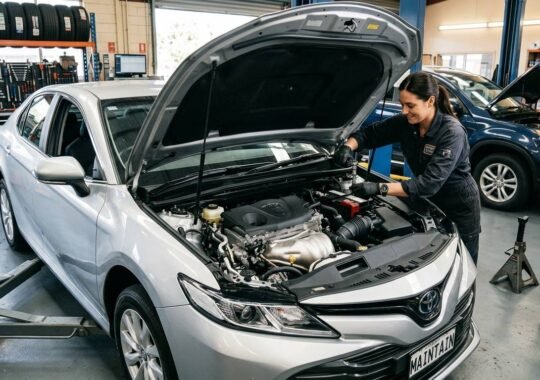
Many drivers experience the costs of poor maintenance months before the repair is absolutely necessary. For example, an oxygen sensor can fail and the engine will compensate with extra fuel to get to the same speed – but the driver won’t notice until the months pass and they’re sitting in a repair shop with a $600 bill. If that sensor had been caught as part of a regular service, the driver wouldn’t have wasted hundreds of miles’ worth of gas or trashed the catalytic converter.
Cascading Failure: How A $50 Part Destroys A $5,000 System
The costliest repairs start with the least expensive maintenance.
A worn thermostat costs almost nothing to replace. Left alone, it disrupts coolant flow, the engine runs hotter than it should, and over time that sustained heat warps cylinder head components. What started as a cheap fix is now a head gasket replacement. A fouled spark plug misfires on every cycle, putting unburned fuel into the catalytic converter until it’s destroyed. Neither of those final repair bills is small.
This is what mechanics mean when they talk about cascading failure. One system compensates for another until it can’t anymore, and by then the original fault is buried under layers of secondary damage. Catching the thermostat early is a $50 decision. Missing it is a $2,000-plus one.
The same logic applies to timing belts. Manufacturers publish replacement intervals for a reason. The belt doesn’t send warning signs before it breaks. When it does break, it can bend valves, destroy pistons, and require full engine reconstruction. Replacement on schedule costs a few hundred dollars. Replacement after failure costs several times that – if the engine is even worth saving.
Fuel Efficiency Is A Maintenance Variable
Many drivers might consider fuel use to be a fixed cost of running a car. But that’s not the case.
It costs around 7% more fuel for an engine to run because of a clogged air filter which restricts airflow into the engine. The same goes for fuel usage because of under inflated tires, with rolling resistance causing a strain with every revolution. And the same goes for fuel consumption because of old engine oil with compromised viscosity making the engine work harder and hotter than it should. None of these factors are especially dramatic by themselves, but combining them shaves up to 10% off a car’s fuel economy. In the context of today’s fuel prices, that’s enough to pay for a year of standard servicing over the course of 12 months of driving.
When To Stop DIY and Book A Professional Inspection
Checking tire pressure, watching for fluid leaks, and monitoring warning lights – these are habits worth building. But there’s a ceiling to what a visual check can find.
Modern vehicles have hundreds of sensors feeding into the OBD-II system, and a triggered Check Engine light can represent anything from a loose fuel cap to early catalytic converter deterioration. Identifying the actual fault requires a scan tool and someone who knows what they’re reading. Similarly, brake pad thickness, suspension wear, and early-stage fluid oxidation aren’t visible without getting under the car properly. A professional car service performed by qualified technicians is the only way to find those deep-seated issues before they become terminal.
This is also where logbook servicing earns its value. Following manufacturer-specified intervals keeps factory warranty conditions intact and creates a documented record of every inspection and replacement – which matters considerably when it’s time to sell.
Maintenance History As A Financial Asset
A verified service record does something most drivers underestimate: it shifts negotiating power during a sale.
Buyers aren’t just purchasing the car as it sits. They’re buying confidence about what’s inside it. A car with complete service records signals that wear has been managed and failures have been anticipated. That perception has real dollar value – a documented maintenance history can increase resale prices by up to 20% compared to an equivalent vehicle sold without records.
Consider that against the depreciation curve. Every car loses value over time, but neglect accelerates that curve. Visible wear, mechanical noise, and an absent service history all push the resale number down. Maintenance is, in the most direct sense, depreciation management.
The AAA “Your Driving Costs” study puts the comparison plainly: a scheduled 50,000km checkup costs a fraction of the average major engine or transmission repair, which typically runs between $3,000 and $7,000.
Treat The Car Like An Investment, Not A Liability
If you think about it from an investor’s point of view, owning a vehicle requires you to put in some capital maintenance. Things like oil changes, replacing filters, checking fluids, and having regular inspections done may not earn you any money directly, but they will help you save money by not having to spend on costly repairs in the future. Additionally, your car will be more fuel-efficient and will maintain a higher resale value. So in the long run, you do get a return on that “investment”.
Every vehicle has a break-even point where deferred maintenance becomes more expensive than the car is worth. Preventive care is what keeps that point as far away as possible.