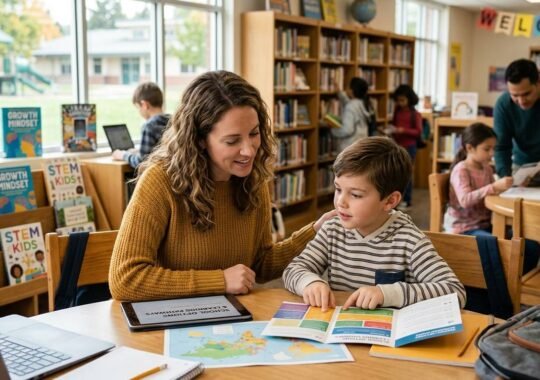

Selecting a secondary school curriculum is not merely an administrative chore – it is one of the most important academic decisions a family can make. The best choice will depend on your child’s learning preferences, university aspirations, and how your family goes about their daily life, not which system seems more elite.
Understanding What The Major Curricula Are Actually Asking Of Students
Before you begin weighing your options, it’s worth understanding what is practically required of you along each pathway.
The GCSE-into-A-Levels route is a two-step staircase of deep but narrow specialization. Typically, at A-Level, a student will be studying three or, at most, four subjects. And the A-Level curriculum is really designed to be quite specialized and university-like in terms of the level of depth you go into, and the sophistication of the areas in the subjects that you’ll be invited to engage with. So, for somebody who, at 15 or 16, is really passionate about a particular subject or even two, three or four subjects, there couldn’t really be a more perfect way to spend two years at school.
That kind of depth is what is expected by the top universities in the UK for entrance, and it’s also what a lot of the more mechanistic university entrance systems that aren’t necessarily competing for innovative, alternative-minded students guarantee when they generate predicted grade offers. The trade-off, of course, is that if you haven’t yet settled on a specific academic subject and you’re not quite sure where you’d like to go with your further and higher education, this specialization can be a little bit uncomfortable.
In contrast, the IB is a one-step staircase to broad and balanced specialization. You’re taking six different subjects at once, and there is absolutely no getting out of spending significant amounts of time doing them all. It’s worth commenting that the IB, as well as just being a completely different culture, is really intended for students who would like to maintain a degree of breadth.
How Universities Actually View These Qualifications
There is a misconception that universities don’t respect qualifications from non-traditional sources. In fact they simply assess whether they know and respect the credential, not the exact source of the credential.
Cambridge IGCSE and International A-Levels from CAIE and Pearson Edexcel’s international qualifications are well established within the UK system and not discriminated by source. If a student earns three solid International A-Level grades through an Online School in the UK and that program is delivering exams through an accredited route, that learner is treated no differently from a student studying in a physical school.
What will be assessed are the grades and the relevance of the subjects. A statement of entry carrying AAB in strong essay-based subjects for someone wanting to read Law in the UK works – that student is good to go. A statement of entry carrying AAB in subjects that don’t match the degree’s entry requirements doesn’t work, because the learner isn’t covering the correct subjects. The same is true when applying at US, Canadian or Dutch universities for example – meeting entry requirements isn’t about school type, it is about getting the right grades in the right subjects.
Domestic UK Qualifications vs. International Equivalents
The difference between domestic UK GCSEs and International GCSEs (IGCSEs) matters more than you’d think, for parents of kids outside the traditional school system.
IGCSEs, which are UK GCSE equivalents, except the name doesn’t carry the same legal protection, are a design for students outside registered schools or with some international link. They tend not to have coursework – sometimes no coursework at all – and they tend to be entirely or mostly exam. If you don’t do well with coursework or want your outcome uninfluenced by teacher-assessed coursework, that isn’t a downside.
International A-Levels are the same. They’re the same entry requirement and used for the same entry setting if you aren’t a student inside a registered UK school. UCAS accepts them. Russell Group unis accept them. It’s not a second tier qualification just because it’s the international version of the British thing.
How Learning Style Should Drive Curriculum Selection
Too many parents waste time and energy worrying about which curriculum and which school will look best on a college application. This is where many parents focus too much on brand recognition and not enough on their child as an individual.
Linear exam-based systems – where the final grade depends almost entirely on end-of-year or end-of-course exams – reward students who can retain information over time, work independently without regular external validation, and perform under pressure. If your child studies consistently, organizes their own revision, and doesn’t unravel in exam conditions, a linear system plays to their strengths.
Modular or continuous assessment systems suit students differently. If your child needs regular checkpoints to stay motivated, benefits from feedback throughout a course rather than only at the end, and performs better when their effort is recognized incrementally, a curriculum with ongoing assessment components will likely produce better outcomes.
Neither profile is a character flaw. Some genuinely brilliant students are poor exam performers. Choosing a curriculum that fights against how your child processes and demonstrates learning is a structural disadvantage that no amount of tutoring fully compensates for.
It’s also worth thinking about STEM subjects specifically. Laboratory-based science subjects have practical requirements that vary by curriculum and delivery method. Some online providers use simulation software to cover practical components, while others partner with local facilities. Before committing to a curriculum, confirm exactly how the practical elements are handled, particularly if your child is aiming toward medicine, engineering, or any university program with specific science prerequisites.
The Practicalities Of Exam Registration As A Private Candidate
Students who are schooled outside a registered learning institution – for instance through online schooling, homeschooling, or a mix of both – typically enter exams as private candidates at approved centers. This is a well-oiled process but it is important to be prepared.
Private candidate registrations necessitate locating an approved center willing to accept external entries, meeting their registration deadlines (which often occur several months before the exam series), and settling exam fees on a subject-by-subject basis (in addition to any teaching fees). Costs vary between boards and centers and some centers charge additional administration fees over and above the standard entry costs.
These deadlines are non-negotiable. Missing a registration period could mean having to wait a whole academic year for the next available series. Parents must plan out their child’s exam timetable at least half a year in advance and confirm center availability at the earliest stage, especially in regions with limited approved centers.
It’s not a deterrent from alternative education pathways, it’s just a timing reality better to anticipate than manage.
The Role Of Structured Online Education
It has been seen that for many students, the medium can be far less important than the message itself. With modern online schools, it’s the same curriculum you’d experience in person, taught by the same teachers – who often appreciate the ability to focus more on their teaching than the administrative duties that come with in-person schooling.
The best online schools also provide strong pastoral support. Just because students aren’t sat at desks in front of a teacher doesn’t mean you don’t need an effective anti-bullying program, a counselor, access to mental health resources, or an academic mentor where necessary.
An online school can assign you a specific mentor who knows your child’s studies inside and out, and who can be on calls with your child several times a week if needed.
At the heart of the decision to transfer to online schooling is a recognition that the world has changed, and that the one-size-fits-all model of in-person schooling doesn’t need to fit this generation. Online education isn’t right for every child, or every adult for that matter, but for the cohort who can succeed in that environment, it can provide the freedom to truly progress at their own pace.
Financial And Resource Planning
There are costs associated with secondary education outside the mainstream school system, and it pays for parents to be open about what these are and where extras might come in as they make their decision.
Tuition is self-explanatory but, over and above that, there are per-subject exam registration fees for each exam session, the cost of school-approved textbooks as some exam boards specify, and any simulation software. Some families also budget for supplementary tutoring in specific subjects, particularly mathematics and sciences at A-Level or International A-Level, where self-study alone can leave gaps. This isn’t a failure of the online model – physical school students frequently use tutors too – but it’s a cost to anticipate.
The overall financial picture for a well-planned online secondary education can be competitive with independent school fees, and in many cases significantly lower. The key is accounting for all costs upfront rather than treating tuition as the only line item.
A Self-Assessment Framework For Parents
Before you base a decision on curriculum, pose these questions:
- Can your child maintain good study habits without daily supervision? If yes, choose asynchronous or hybrid online delivery. If no, opt for a curriculum with a higher percentage of live lessons.
- Does your child already know what they enjoy academically, or are they still trying to figure that out? Specialized curricula work for students with set interests. Breadth-based ones work for those who need more time.
- What are the realistic university options? If you know it’s the UK, go for A-levels or International A-levels. If it’s worldwide, choose the IB or strong international qualification.
- What’s your actual family lifestyle like? For frequently relocating families, those with irregular schedules, or a student who prefers working alone, online is probably the best solution.
The choice isn’t “for life” in the way it sometimes seems at first. Kids change and so do circumstances, not to mention that most online providers will let you switch a subject in the early stages of a course. The point is to make an informed starting decision, not a perfect one.
If you choose based on the reality of your child’s strengths rather than the perceived prestige of a name, you’re already doing a lot better than those who go with the hyped-up option and hope their child fits.