A $3,000 briefcase cannot be explained by utility alone. Less costly cases can carry the same laptop and papers. A serious luxury briefcase must first fit the owner’s work, but its desirability and value come from something more exacting: leather that reveals its natural character, and construction that concentrates years of difficult hand skill. It should be judged as functional art.
The buying decision therefore has four parts. Functional fit determines whether the case belongs in your life. Material quality determines how it feels, responds, and matures. Construction determines whether the maker has transformed that material with genuine mastery. Durability determines whether long ownership is supported by the object and its warranty. None can stand in for the others.
Four Judgments to Make Before Buying
Functional fit: choose a silhouette, depth, closure, and interior that suit the setting and the daily load.
Material quality: look beyond grade names to tanning method, surface finish, visible grain, and the way the leather changes through handling.
Construction and craft: inspect edges, seams, lining, structure, and the difficulty of the operations used to make them.
Durability and ownership economics: judge whether construction, materials, and warranty can sustain decades of use, then weigh cost across the ownership horizon and the enjoyment it returns.
This hierarchy matters. A case that does not fit will remain at home. A case that only fits is equipment. Luxury begins when usefulness is joined by material beauty and rare construction.
First Judgment: Functional Fit
The correct briefcase is determined by the normal working day, not by job title alone and not by the maximum load carried once a year. Start with what must remain orderly, protected, and easy to reach on a typical busy day. That pattern should determine the case’s depth, interior layout, opening, and carrying method.
Paper-Led Work: Files Must Remain Usable
Lawyers, notaries, advisers, and others who move between contracts, folders, marked documents, and a laptop should look first at document capacity. A useful case gives papers enough room to remain flat rather than curl against a computer or closure. A broad opening makes it easier to remove one file without disturbing the rest, while structured separation keeps active papers apart from the laptop and personal items. An upright form can help folders stay aligned when the case is placed beside a desk or meeting table. Because paper adds weight quickly, handles and any shoulder strap should remain comfortable when the usual file load is inside.
Digital-Heavy Work: Organisation Matters More than Empty Volume
A laptop, tablet, chargers, cables, power bank, mouse, headphones, and small adapters create a different problem. The challenge is not simply capacity, but controlled separation. A suitable interior gives primary devices their own protected zones, keeps small accessories visible, and places frequently used items within quick reach. Cables and hard objects should not share loose space with screens or press against a laptop when the case closes. Several deliberate compartments often serve this load better than one large undivided cavity, even when both cases have the same outer dimensions. The aim is to retrieve a charger or adapter without emptying the case onto a table.
Laptop-Only Work: Restraint is the Better Fit
For a laptop and perhaps one notebook or charger, minimal capacity is not a compromise. A slim profile, low empty weight, and limited organization keep the case proportionate to its contents. Close-to-body carry is easier when unused depth does not pull the case outward, and a few purposeful pockets prevent the interior from becoming busier than the working day requires.
Use a simple professional-fit test before buying. Lay out the normal busiest-day load, then group it into paper, primary devices, and accessories. Each group should have a deliberate place, and the item used most often should be retrievable without unpacking the rest. Check the case against that arrangement rather than an abstract capacity figure. Unusual travel days are usually better handled by a second travel bag than by oversizing the briefcase carried every day.
Second Judgment: Material Quality
Leather quality is not settled by the phrase “full-grain.” That hierarchy is too simple to explain how a case will age. Tanning method, surface finish, hide selection, cut, and the presence of oils and waxes tell the buyer far more.
Lunburg’s unsealed vegetable-tanned aniline leather makes those distinctions visible. Vegetable tanning stabilises the hide with plant extracts. Aniline leather is coloured with transparent dyes rather than covered by an opaque pigment layer. The surface remains open, so the natural grain itself is what the hand and eye encounter. Marks are not disguised beneath a uniform coating. Selecting clean hides for large, uninterrupted panels therefore carries a material cost.
The leather is infused with natural oils and waxes. When a minor scuff appears, light thumb pressure can redistribute them across the grain and let the mark settle. This is not immunity from use. It is a different relationship with use: the surface can recover instead of accumulating damage as a dead coating.
Time provides the final material test. The colour deepens, the surface develops a soft sheen, and the leather gradually moulds to its owner. Patina is not simply wear made respectable. It is the richer colour and individual surface that emerge because the grain was left visible and able to mature. A luxury briefcase should become more personal through use, not merely look older.
Third Judgment: Construction and Craft
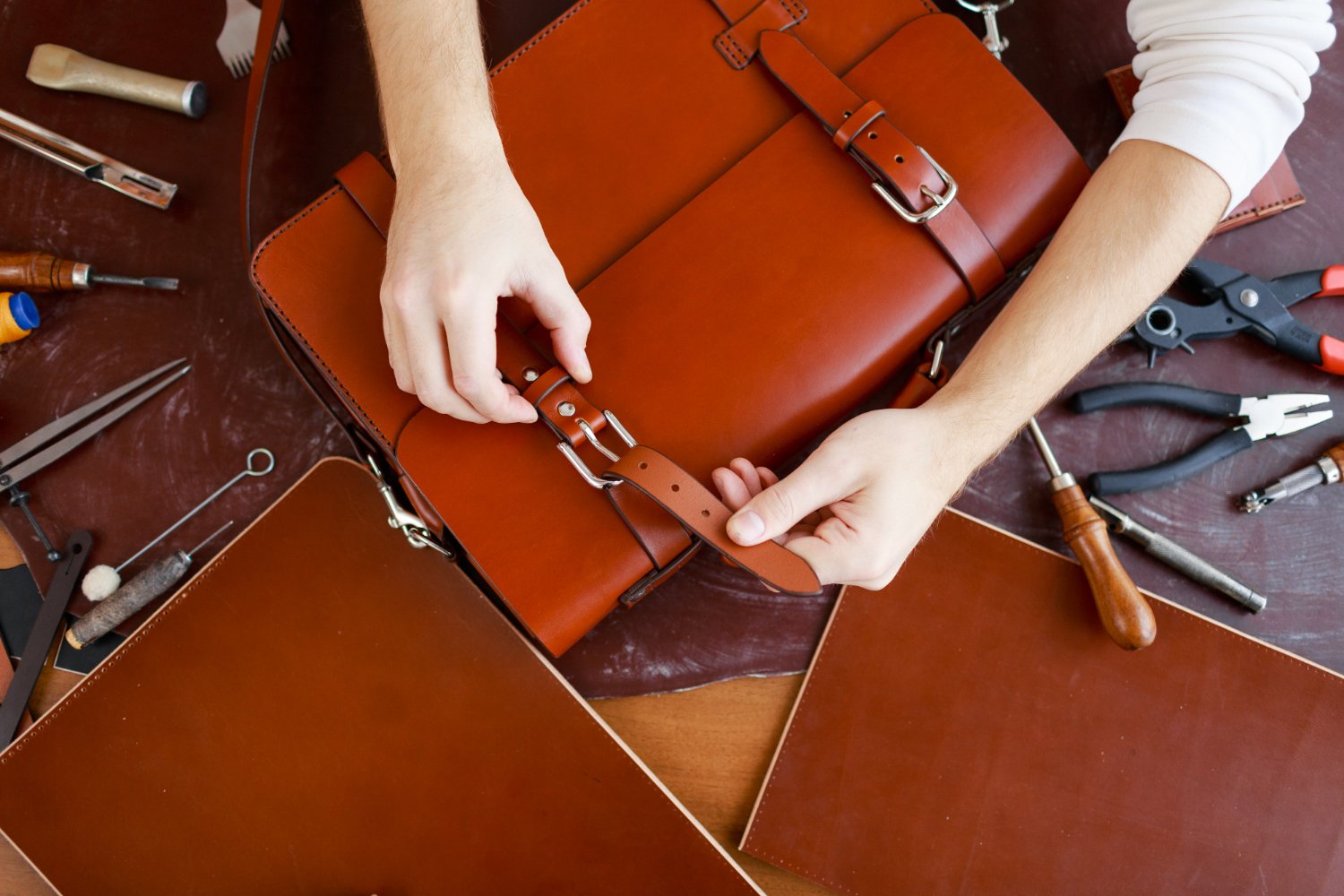
The clearest place to judge leathercraft is the edge, especially around a handle. In turned-edge construction, also known as Rempliage, the artisan skives, or thins, the leather and folds it inward so the grain wraps continuously over the edge. No cut face remains exposed. There is no edge paint laid over it. The surface and edge can therefore mature as one.
The apparent simplicity conceals severe difficulty. Skiving must reach a tolerance of 0.1 millimetres, with as many as four configurations on one panel. The artisan then folds with consistent pressure, hammers the folded edge flat, and compresses four to six layers on a wooden form. These operations are irreversible. A small error made early cannot be concealed by a final coat.
Rempliage is the highest level of leathercraft skill, practiced by only a few artisans globally. Competency takes eighteen months, while mastery takes fifteen to twenty-five years. On a single Opus, the technique consumes more than 80 percent of artisan time, with about thirty metres of hand-folded edge formed across roughly sixty-six hours of labour.
Why Rempliage is Leathercraft’s Grand Complication
In mechanical watchmaking, a grand complication combines several demanding functions; the analogy here concerns mastery, not added utility. Its value lies in concentrated mastery, irreversible operations, and precision that largely disappears into the finished form. A person need not be able to execute either discipline to understand the difficulty embodied in the object.
That is why exceptional construction can be desired beyond its practical result. The uninterrupted grain, the absence of a coating, and the calm geometry of a folded edge are visible expressions of control. Much of the real precision remains inside the fold. Craft at this level rewards knowledge as well as sight.
The rest of the case should meet the same standard. A high-craft interior is built rather than merely lined, with functional leather pockets and dividers. Structure should hold cleanly without warping. Hardware should support the construction instead of distracting from it. Lunburg uses corrosion-resistant 316L stainless steel, places no exterior logo on its pieces, and backs its structure with a fifty-year warranty.
Fourth Judgment: Durability and Ownership Economics
Durability begins with what has been left out. Rempliage, the folded-edge technique in which leather turns back upon itself, leaves no edge paint to crack or peel. The open aniline surface is likewise made to live with handling: natural oils and waxes can redistribute under light thumb pressure to settle minor scuffs, while years deepen its colour and patina, the surface character formed through use. Beneath that visible ageing, structure is supported by a fifty-year warranty.
That horizon changes the financial judgment. $3,000 divided across 600 months is $5 per month. That is less than many Starbucks drinks, yet the value is not confined to avoiding another purchase. The owner handles functional art in every interaction, and the object becomes more beautiful and more personal as the leather records a life.
A cheap briefcase replaced every five years means ten bags purchased across fifty years, or nine replacements after the first. This does not require a claim that their combined cash price must be higher. The superior financial decision rests on something broader: longevity, warranty-backed use, avoided replacement cycles, and daily enjoyment. One object remains present long enough to gather memory, rather than sending its owner back to the beginning every five years.
Bringing the Four Judgments Together
The Lunburg Opus briefcase was conceived to maximize all four judgments rather than trade one against another. Its three interior approaches answer paper-led, digital-heavy, and laptop-first work, so professional fit begins with the way the owner works, not a generic capacity checklist. Its unsealed aniline leather leaves the natural grain visible and open to touch. As handling deepens the colour, develops a soft sheen, and shapes the leather to its owner, the case becomes richer and more personal with time.
Turned-edge construction carries that grain continuously around the edge, a quiet expression of rare mastery rather than applied decoration. A fifty-year warranty supports an ownership horizon measured in decades, allowing daily enjoyment to accumulate instead of restarting with each replacement. Utility establishes fit; material, craft, and durability explain why the object is worth living with. In the Opus, usefulness and beauty are joined as functional art.