
Introduction

Every minute counts in an automotive shop. Downtime costs money and hurts your reputation. Reliable equipment is not just a luxury; it’s a necessity for smooth operations.
The air compressor system is often the unseen backbone of your business. It powers everything from impact wrenches and tire changers to sandblasters and paint guns. Without clean, dry, and consistently pressurized air, your workflow grinds to a halt.
A poorly planned or installed air system can lead to constant headaches. These include equipment failures, wasted energy, and even safety risks. We understand the critical role these systems play. We will guide you through every step of building a robust air compressor setup for your shop. For comprehensive support with your shop’s needs, including automotive equipment sales and installation, consider partnering with experts.
This extensive guide will cover everything you need to know. We will discuss selecting the right compressor type and size. We will also look at electrical needs, proper piping, and essential air treatment. Finally, we will cover safety compliance and ongoing maintenance. Our goal is to help you minimize downtime and boost your shop’s efficiency.

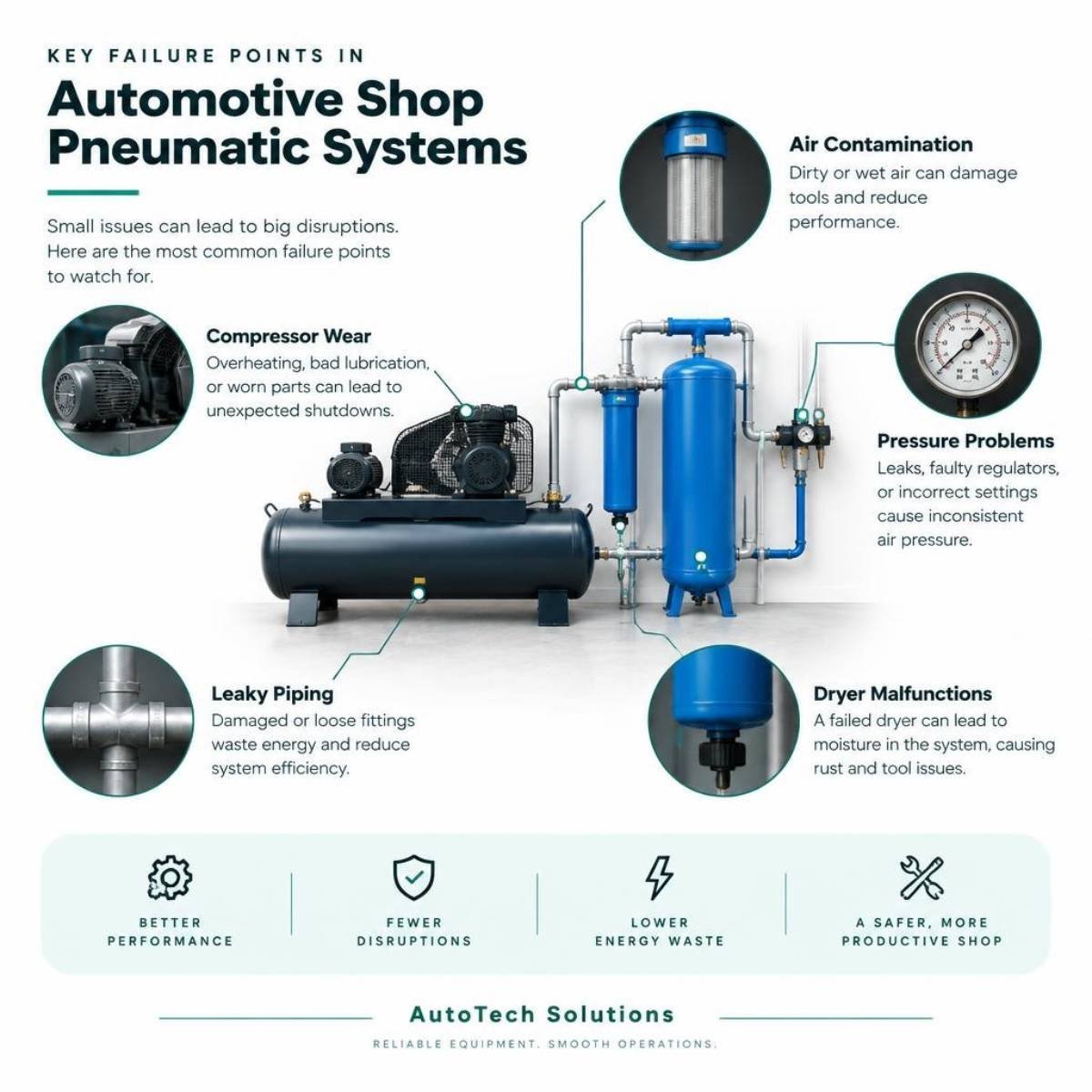
Essential Automotive Shop Equipment and Maintenance Strategies
Choosing the correct air compressor is the foundational step for any automotive shop. It’s not merely about having compressed air; it’s about having the right compressed air, delivered efficiently and reliably. This decision impacts everything from tool performance to energy bills and overall shop productivity.
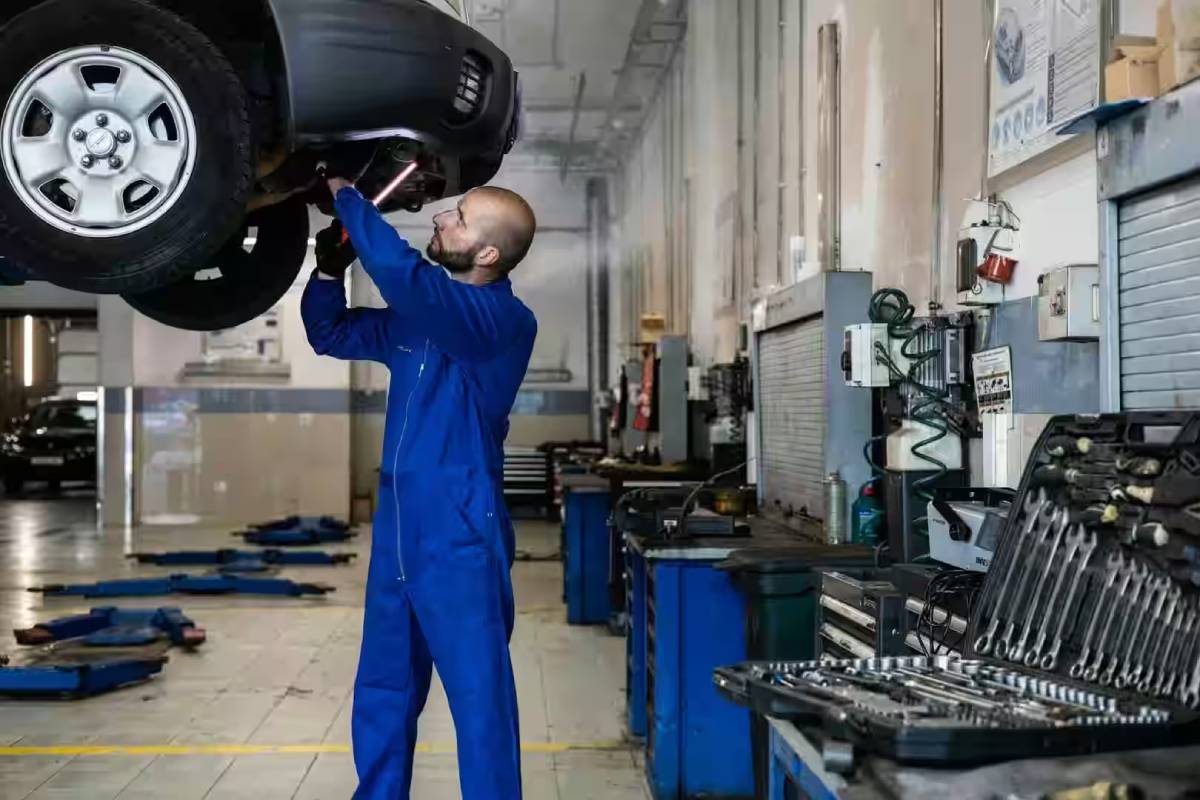
Sizing Pneumatic Systems for Peak Demand
Properly sizing your air compressor system requires a careful assessment of your shop’s specific needs, considering both current operations and future growth. Overlooking this step can lead to an undersized system that struggles to keep up, or an oversized one that wastes energy and shortens component lifespan.
The primary metrics we consider are Cubic Feet per Minute (CFM), Pounds per Square Inch (PSI), and Horsepower (HP).
- CFM (Cubic Feet per Minute): This is the volume of air the compressor can deliver. It’s arguably the most critical factor, as it dictates how many tools can run simultaneously and for how long. For automotive repair, a general rule of thumb suggests that each technician uses approximately 5 CFM of compressed air. However, this is a baseline. We must also factor in the CFM requirements of your most “air-hungry” tools, such as sandblasters (which can demand 10-20+ CFM), paint guns (5-15 CFM), and heavy-duty impact wrenches (4-10 CFM). Always select a compressor whose CFM output at 90 PSI exceeds the requirement of your most demanding tool.
- PSI (Pounds per Square Inch): This measures the air pressure. Most air tools in an automotive shop operate optimally at 80-90 PSIG (gauge pressure). Your system’s pressure should be set to accommodate the highest-pressure tool you regularly use, with individual regulators at workstations to step down pressure for tools requiring less.
- HP (Horsepower): This indicates the motor’s power. While important, HP alone isn’t the best indicator of air output; CFM is more telling. A 5 HP compressor might deliver vastly different CFM depending on its design.
When sizing for multiple technicians and tools, we use a “use factor.” This accounts for the fact that not all tools run continuously. For example, if you have five technicians, and each might use an impact wrench (intermittent use) and one might be using a continuous tool like a sander or paint gun, your calculation would look like this:
- Continuous Tools: Sum the CFM for any tools that run constantly (e.g., a paint booth’s air supply, a plasma cutter).
- Intermittent Tools: For tools used in short bursts (impact wrenches, tire inflators), take the highest CFM of these tools and multiply by a “use factor” (e.g., 20-50%) for the number of technicians.
- Total CFM: Add these figures together. It’s always wise to add a 10-20% buffer for future expansion or unexpected demands.
The choice between reciprocating (piston) compressors and rotary screw compressors is also crucial. Small automotive shops often start with 5 to 7.5 HP reciprocating compressors due to their lower initial cost. However, these units have a limited duty cycle, typically around 30 minutes per hour, meaning they need to rest to cool down. Running them beyond this limit risks overheating and premature failure. As shops grow and demand for continuous air increases (e.g., for multiple technicians, sandblasting, or paint booths), most outgrow these smaller units.
Rotary screw compressors are generally the best choice for busy automotive shops. They are designed for 100% duty cycle, meaning they can run continuously without needing to cool down. They are also significantly quieter, more energy-efficient for continuous operation, and have a longer lifespan, making them a wise long-term investment for commercial environments.
Automotive Shop Equipment and Maintenance for Commercial Air Compressors
Once your compressor is installed, a robust maintenance schedule is paramount to ensure its longevity and reliable performance. For commercial-grade compressors, this goes beyond simply draining the tank.
Key maintenance tasks include:
- Oil Changes: Just like an engine, the compressor pump’s oil needs regular changing to prevent wear and ensure efficient operation. Follow manufacturer recommendations, typically every few hundred to a few thousand hours of operation.
- Belt Tensioning: For belt-driven compressors, belts can stretch over time. Proper tension is vital for efficient power transfer and to prevent slippage or excessive wear.
- Intake Filtration: The air entering your compressor must be clean. Regularly inspect and replace intake filters to prevent dust and debris from entering the compressor pump, which can cause significant damage.
- Condensate Drainage: Compressed air generates moisture. This condensate collects in the receiver tank and must be drained regularly – ideally daily for high-humidity environments or heavily used systems. Failure to do so reduces tank capacity, promotes rust, and introduces moisture into your air lines. Automatic drain valves can simplify this critical task.
- Oil/Water Separation: A significant concern for commercial shops is the disposal of compressor condensate. A 100 HP compressor, for instance, can generate up to 10 gallons of oil-laden condensate annually in a single-shift operation. This oily water cannot be simply discharged into the sewage system. EPA limits for oil in wastewater are typically less than 100 ppm. Installing an oil/water separator is essential to meet environmental regulations and avoid costly fines.
Regular preventative maintenance minimizes unexpected breakdowns, extends the life of your equipment, and ensures consistent air quality, directly contributing to minimizing downtime.
Designing High-Efficiency Air Distribution and Plumbing Networks
A well-designed air distribution system is as critical as the compressor itself. Even the best compressor will underperform if the piping network is inefficient, leaky, or introduces contaminants. Our goal is to deliver clean, dry air at the required pressure to every workstation with minimal pressure drop.
Selecting Piping Materials and Sizing Layouts
The choice of piping material significantly impacts system performance, longevity, and safety. While many DIY guides might mention PVC, we strongly advise against its use in any compressed air system due to severe safety risks.
Comparison of Common Air Piping Materials
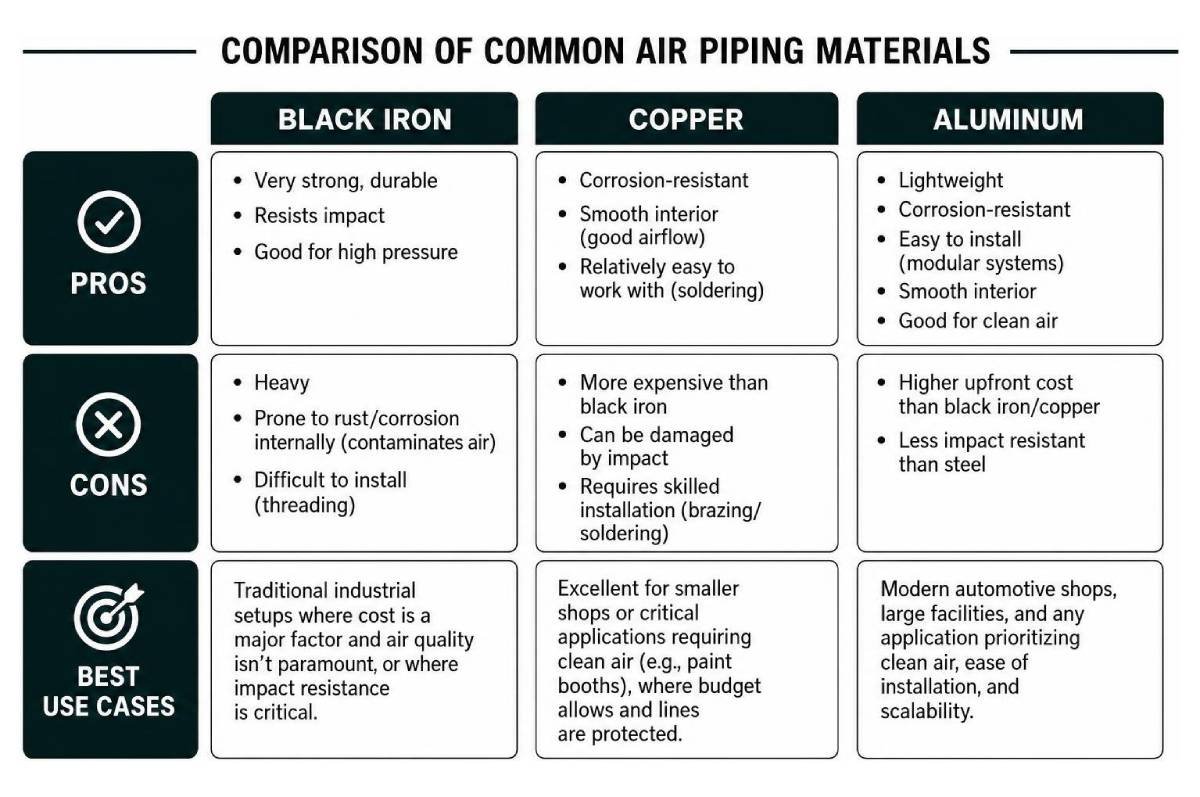
Material Pros Cons Best Use Cases Black Iron Very strong, durable, resists impact, good for high pressure. Heavy, prone to rust/corrosion internally (contaminates air), difficult to install (threading). Traditional industrial setups where cost is a major factor and air quality isn’t paramount, or where impact resistance is critical. Copper Corrosion-resistant, smooth interior (good airflow), relatively easy to work with (soldering). More expensive than black iron, can be damaged by impact, requires skilled installation (brazing/soldering). Excellent for smaller shops or critical applications requiring clean air (e.g., paint booths), where budget allows and lines are protected. Aluminum Lightweight, corrosion-resistant, easy to install (modular systems), smooth interior, good for clean air. Higher upfront cost than black iron/copper, less impact resistant than steel. Modern automotive shops, large facilities, and any application prioritizing clean air, ease of installation, and scalability. PEX Flexible, easy to install (push-to-connect fittings), corrosion-resistant, relatively inexpensive. Lower pressure and temperature ratings than metal, UV degradation if exposed, less rigid. Smaller shops, non-critical applications, or as drops from a main line where flexibility is an advantage. PVC None for compressed air. Becomes brittle with age/UV, shatters violently under pressure (shrapnel hazard), not rated for compressed air. ABSOLUTELY AVOID FOR COMPRESSED AIR. For most modern automotive shops, aluminum modular piping systems offer the best balance of performance, ease of installation, and air quality. They are lightweight, corrosion-resistant, and their smooth interiors minimize pressure drop.
Layout Considerations:
- Loop Mains: A “loop” system, where the main air line forms a closed circuit around the shop, is highly recommended. This allows air to flow from two directions to any drop, minimizing pressure fluctuations and ensuring consistent pressure at all points.
- Pipe Sizing: Undersized pipes lead to significant pressure drop. We generally recommend 1-inch or larger main lines for most automotive shops, with 1/2-inch or 3/4-inch lines for individual drops. Consult a professional to calculate precise sizing based on your total CFM demand and pipe run lengths.
- Drop Legs: Install “drop legs” (vertical pipes extending downwards) at each workstation. These should come off the top or side of the main line to prevent condensate from flowing into your tools.
- Sloping: Main lines should be sloped slightly (e.g., 1/4 inch per 10 feet) towards a drain point or a strategically placed drop leg to facilitate condensate removal.
- Sealing: Use pipe dope specifically designed for compressed air systems, or high-quality PTFE tape, on all threaded connections. Pipe dope often provides a more reliable seal and prevents tape shredding, which can clog tools.
Advanced Air Filtration and Moisture Management
Moisture and contaminants are the enemies of pneumatic tools and paint finishes. Even with regular tank draining, the air leaving the compressor is saturated with water vapor and can carry oil aerosols. Proper air treatment is essential.
Key air treatment components include:
- Aftercooler: Installed immediately after the compressor, an aftercooler cools the hot compressed air, causing a significant portion of the water vapor to condense into liquid, which can then be drained. This is the first line of defense against moisture.
- Refrigerated Air Dryers: These are the most common dryers for automotive shops. They cool the compressed air to a few degrees above freezing, causing more water vapor to condense. The liquid water is then automatically drained. This results in air with a dew point typically around 38°F (3°C), suitable for most general shop applications and even some painting.
- Desiccant Air Dryers: For applications requiring extremely dry air, such as high-quality paint booths or sensitive electronic equipment, desiccant dryers are necessary. They use a desiccant material to absorb moisture, achieving dew points as low as -40°F (-40°C). These are more expensive to operate but provide superior air quality.
- Filters:
- Particulate Filters: Remove solid particles like rust, dirt, and pipe scale. A 5-micron filter is a good general-purpose choice.
- Coalescing Filters: Designed to remove oil aerosols and finer particulate matter (down to 0.01 microns). These are critical upstream of refrigerated dryers to protect them and downstream for paint applications.
- Activated Carbon Filters: Used for removing oil vapor and odors, essential for paint booths where even trace amounts of oil vapor can ruin a finish.
- Regulators: While the main system pressure might be 120-150 PSI, most tools only need 80-90 PSI. Install point-of-use regulators at each workstation to provide the correct pressure for specific tools, preventing over-pressurization and extending tool life.
- Auto-Drain Valves: These automatically purge condensate from filters, dryers, and receiver tanks, eliminating the need for manual draining and ensuring consistent moisture removal.
The placement of these components is crucial. The dryer should be installed after the aftercooler (if present) and primary filters, but before the main distribution lines. Point-of-use filters and regulators should be installed directly before the air hose connection at each drop leg.
Optimizing Facility Layout, Electrical Infrastructure, and Safety
The physical placement of your compressor and the integrity of your electrical system are paramount for both performance and safety. A poorly located compressor can be a nuisance, and inadequate electrical service can lead to constant issues.
Best Practices in Automotive Shop Equipment and Maintenance Protocols
Compressor Location and Ventilation:
- Remote Placement: Reciprocating compressors, in particular, can be very loud, often exceeding 85 dBA. OSHA mandates hearing protection when noise levels exceed 85 dBA. Placing the compressor in a dedicated, remote compressor room or a separate utility area significantly improves the working environment and reduces noise exposure for technicians.
- Ventilation: Compressors generate a lot of heat. Adequate ventilation is crucial to prevent overheating, which can lead to inefficiency and premature failure. Ensure ample clearance around the unit (typically 18-24 inches on all sides) and provide a continuous supply of cool, clean air. Exhaust fans may be necessary to vent hot air outside. Avoid dusty areas, as this will quickly clog intake filters.
Electrical Requirements:
- Single-Phase vs. Three-Phase: For commercial automotive shops, three-phase power is highly recommended for compressors 5 HP and above. Compressors operating on three-phase service consume less electricity, deliver more output, and experience fewer breakdowns compared to single-phase units. While initial installation might be more complex, the long-term benefits in efficiency and reliability are substantial.
- Dedicated Circuits: All large compressors require a dedicated electrical circuit. This prevents the compressor from tripping breakers or causing brownouts for other equipment. The circuit must be sized appropriately for the compressor’s HP and voltage, accounting for startup amperage, which can be 5-7 times the running amperage. For example, a 5-horsepower, 230-volt motor might have a 23-amp running rating but require a 30-amp dedicated circuit to handle startup spikes. Always consult with a licensed electrician to ensure proper wiring and compliance with local codes.
Safety Considerations and OSHA Compliance:
- Pressure Relief Valves: Every air receiver tank must have a properly functioning pressure relief valve to prevent over-pressurization, which could lead to catastrophic failure. These should be regularly inspected.
- Lock-Out/Tag-Out (LOTO): Implement strict LOTO procedures for any maintenance or repair work on the compressor or air system. This ensures that power is safely disconnected and cannot be accidentally re-energized.
- Hearing Protection: As mentioned, if noise levels exceed 85 dBA, provide and enforce the use of hearing protection for all employees.
- Guards: Ensure all moving parts, such as belts and pulleys on belt-driven compressors, are properly guarded to prevent accidental contact.
- Regular Inspections: Conduct routine visual inspections of the entire air system for leaks, damaged hoses, or worn components.
- Condensate Disposal: Adhere to all local environmental regulations for condensate disposal, utilizing oil/water separators where necessary.
Frequently Asked Questions About Commercial Shop Air Systems
How do you calculate CFM requirements for multiple automotive technicians?
To accurately calculate CFM for multiple technicians, we start with a baseline of approximately 5 CFM per technician. However, this needs refinement. We identify all continuous-use tools (e.g., paint booth air supply, plasma cutters) and sum their CFM requirements. For intermittent tools (impact wrenches, tire inflators, grinders), we apply a “use factor.” This means we don’t assume every technician is using their highest-CFM intermittent tool simultaneously. Instead, we might take 20-50% of the total intermittent tool CFM across all technicians and add it to the continuous demand. Finally, we add a 10-20% reserve capacity to accommodate peak demands, future tool additions, or slight inefficiencies. This comprehensive approach ensures your compressor can handle your shop’s busiest moments without running out of air.
Why should PVC piping never be used for compressed air lines?
PVC piping should never be used for compressed air lines under any circumstances. While it’s common for water plumbing, PVC is inherently brittle and not designed to withstand the internal pressures and rapid temperature fluctuations inherent in compressed air systems. Over time, or with even a minor impact, PVC can become extremely fragile. When it fails under pressure, it doesn’t just crack; it shatters explosively, sending dangerous, sharp shrapnel flying at high velocity. This poses an extreme safety hazard to personnel in the shop and can cause significant property damage. Using PVC for compressed air is also a serious OSHA violation. Always opt for materials specifically rated for compressed air, such as aluminum, black iron, or copper.
When should an auto repair shop transition from reciprocating to rotary screw compressors?
An auto repair shop should strongly consider transitioning from a reciprocating (piston) compressor to a rotary screw compressor when its air demand becomes continuous or consistently high. This typically occurs as the shop expands, adds more technicians, or begins performing air-intensive tasks like extensive sandblasting, continuous grinding, or operating a paint booth. Reciprocating compressors have a limited duty cycle (e.g., 30 minutes on, 30 minutes off), and running them beyond this limit leads to overheating, reduced efficiency, excessive noise, and premature failure. Rotary screw compressors, by contrast, are designed for 100% duty cycle, offering continuous air delivery. They are also significantly quieter, more energy-efficient for constant use, and provide a more stable air supply, which is critical for consistent tool performance and high-quality paint finishes. The initial investment is higher, but the long-term benefits in reliability, efficiency, and a better working environment make it a worthwhile upgrade for a growing commercial operation.
Conclusion
Investing in a properly designed and installed air compressor system is one of the most impactful decisions you can make for your automotive shop. From selecting the right compressor type and size to meticulous plumbing, advanced air treatment, and robust safety measures, every detail contributes to your operational efficiency and bottom line. By prioritizing these elements, you ensure not just a supply of air, but a reliable, clean, and consistent power source that minimizes downtime, extends tool life, and ultimately enhances your shop’s productivity and profitability for years to come.