Table of Contents
- Introduction
- Why the First 48 Hours Matter
- Get Medical Care and Reach Safety
- Report the Fall to the Resort
- Document the Scene and Preserve Evidence
- How Casino Resort Liability Is Evaluated
- When a Guest May Share Responsibility
- Potential Damages After a Casino Fall
- Mistakes to Avoid
- Nevada Filing Deadlines
A slip-and-fall at a Las Vegas casino resort can turn a vacation, convention trip, or night out into a painful and expensive disruption. Wet pool deck surfaces, spilled drinks, polished flooring, uneven walkways, loose carpeting, poor lighting, and crowded casino aisles can all pose risks. After receiving appropriate medical care, speaking with a Las Vegas personal injury lawyer may help an injured visitor understand how the Nevada premises liability law may apply to the specific facts.
A fall alone does not automatically make a casino or hotel legally responsible. Liability usually turns on what caused the fall, whether the resort knew or reasonably should have known about a dangerous condition, whether it had enough time to address the issue, and whether the guest’s own actions contributed to the accident. Fast action can protect both health and important evidence.
Why the First 48 Hours Matter
Resort properties change quickly. A spill may be cleaned, a warning cone may be moved, a broken tile may be repaired, and surveillance footage may eventually be overwritten. Meanwhile, pain from a sprain, fracture, back injury, or concussion may become more noticeable after the initial shock fades. Early reporting, treatment, photographs, and notes can create a clearer record of what happened.
These steps do not guarantee a successful insurance claim or lawsuit. Every case depends on the condition at issue, available evidence, medical evidence, resort policies, witness accounts, and Nevada law. Still, careful documentation may prevent avoidable disputes later.
Get Medical Care and Reach Safety
First, move away from the immediate hazard if it is safe to do so. Do not try to stand or walk if there is severe pain, numbness, dizziness, confusion, or a possible head, neck, back, or hip injury. Ask casino security or another guest to call 911 when emergency help is needed.
Even if the injury seems minor, consider prompt medical evaluation. Describe all symptoms, including headache, nausea, swelling, reduced range of motion, tingling, or pain that appears when walking. Follow discharge instructions, attend recommended follow-up appointments, and keep records of every visit, prescription, and out-of-pocket expense.
Report the Fall to the Resort
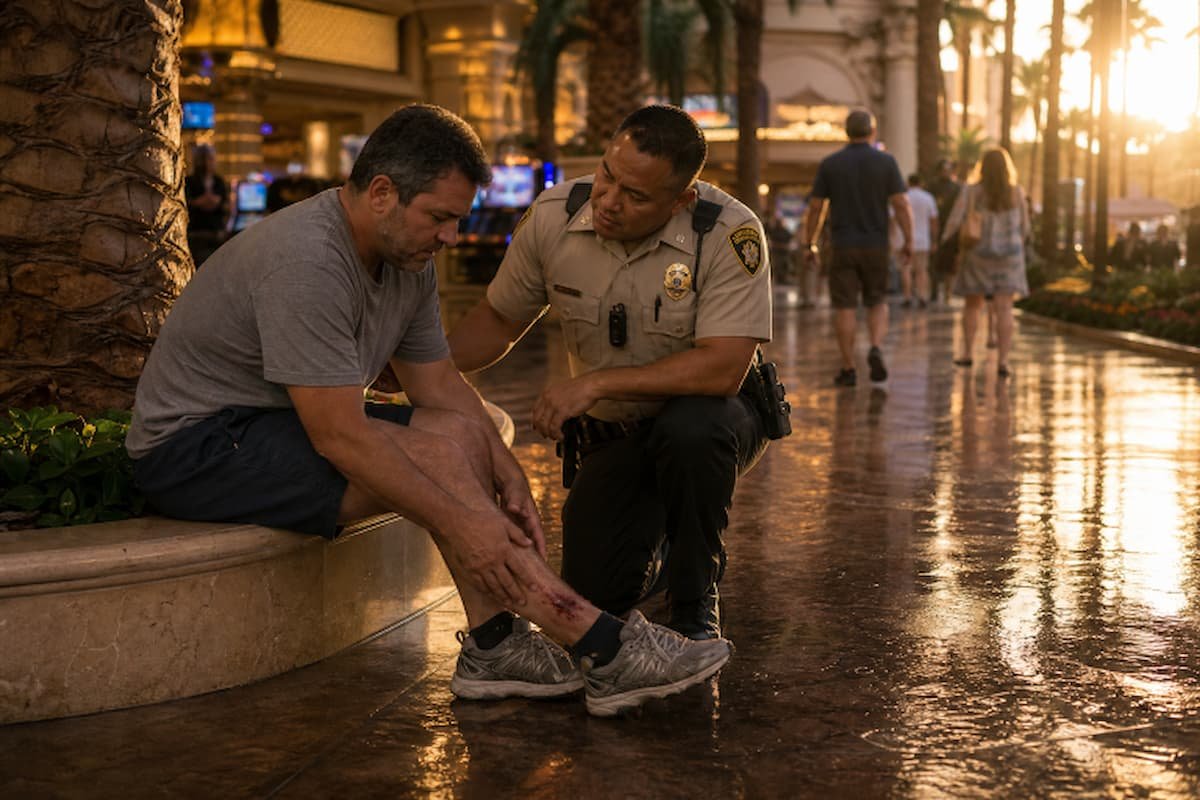
Notify a casino supervisor, hotel manager, security officer, or risk-management representative before leaving whenever possible. Request that the resort prepare an incident report, then record the report number, the names and job titles of the employees involved, the time of the report, and the exact location of the fall.
Give an accurate, basic account of events, but avoid guessing about details you do not know. Do not agree that you were at fault simply because an employee suggests it, and do not sign a broad release or accept payment for your injury without first understanding what the document covers.
Document the Scene and Preserve Evidence
If your condition allows, take photographs and short videos before the area is altered. Capture the floor or walkway from several angles, the substance or defect involved, lighting conditions, warning signs or their absence, nearby cameras, footwear, and the broader area around the hazard. Wide images establish context, while close images can show surface details.
Ask witnesses for their names, phone numbers, and email addresses. A witness may have seen an employee walk past a spill, noticed the condition earlier, or observed that no warning sign was present. Also, preserve the shoes and clothing worn at the time of the accident. Do not wash, repair, discard, or alter them if they may help show what occurred.
Requesting Video Evidence
Large resorts commonly use security cameras in public areas, but footage is not necessarily retained forever. Record the camera locations, the approximate time window, and your route through the property. A written request to preserve relevant video, incident reports, cleaning logs, inspection records, and employee information may be important during a claim evaluation.
How Casino Resort Liability Is Evaluated
Casino resorts generally owe lawful guests a duty to use reasonable care in maintaining areas open to the public. In a slip-and-fall claim, the central question is often whether the property operator created the dangerous condition, actually knew about it, or should have discovered it through reasonable inspections and maintenance.
For example, a claim may involve a drink spill that remained on a busy casino floor without cleanup or warning, a leaking ice machine, a recently mopped surface without adequate caution signs, a damaged stair tread, or poor lighting near an elevation change. Evidence of inspection schedules, employee observations, prior complaints, cleaning procedures, and the duration the hazard existed can all matter.
More than one business may be involved. The casino brand, hotel operator, property owner, restaurant tenant, nightclub, cleaning contractor, or maintenance company may have separate responsibilities for the area where the fall happened. Identifying the correct parties requires a close review of the location and operations involved.
When a Guest May Share Responsibility
A resort may argue that the guest was distracted, ignored a visible warning, wore unsuitable footwear, entered a restricted area, or failed to watch where they were walking. Nevada follows comparative negligence rules, so a person’s percentage of fault can affect recovery. The state’s comparative negligence statute provides that recovery may be reduced by the claimant’s negligence and barred when the claimant is more than 50 percent responsible.
These defenses are fact-specific. A warning sign is not always enough to end the inquiry, particularly if it was poorly placed, hard to see, unrelated to the exact hazard, or inadequate for the circumstances. Conversely, a condition that was open and obvious may be harder to connect to resort negligence.
Potential Damages After a Casino Fall
When negligence caused an injury, a claim may seek compensation for reasonable medical expenses, future treatment needs, lost income, reduced earning capacity, and physical pain or emotional distress. The available damages depend on the medical evidence, the seriousness and duration of the injury, proof of financial losses, and the degree of fault assigned to each party.
Keep bills, medical records, receipts, wage statements, work restrictions, travel costs, and a simple daily journal describing symptoms and limitations. This information can help connect the accident to the practical effects it has had on your life.
Mistakes to Avoid
- Leaving without reporting the incident to the resort staff.
- Failing to photograph the hazard, the surrounding area, and visible injuries.
- Assuming pain will disappear and delaying necessary medical care.
- Posting opinions, accusations, or injury updates on social media.
- Giving a recorded statement that includes speculation or inaccurate details.
- Throwing away the shoes or clothing worn during the fall.
- Signing a release or accepting a quick settlement without reviewing its consequences.
Nevada Filing Deadlines
Deadlines can be critical. Nevada law generally provides a two-year period for an action seeking damages for personal injuries caused by another person’s wrongful act or neglect, although exceptions can apply depending on the facts and parties involved. The current wording of Nevada’s limitation periods for injury claims should be reviewed carefully, as waiting too long can bar the ability to bring a case.
A casino slip and fall should be treated seriously from the start. Prioritize safety and medical care, report the event, preserve evidence, and keep a clear timeline. Those practical steps can make it easier to determine whether a resort failed to address a preventable hazard and whether a legal claim may be available.