Key Takeaways
- The right family SUV fits daily life, not just a showroom first impression.
- Safety, child-seat fit, cargo access, comfort, and ownership costs all deserve attention.
- Two-row SUVs can be a smarter match than three-row models for many smaller families.
- Gas, hybrid, plug-in hybrid, and electric SUVs suit different driving and charging habits.
- A realistic test drive can expose issues that specifications alone do not show.
Table of Contents
- Start With Daily Driving Needs
- Choose Between Two Rows and Three Rows
- Check Safety Ratings and Child-Seat Fit
- Compare Cargo Space in Real Life
- Pick the Right Powertrain
- Review Comfort and Convenience Features
- Estimate Full Ownership Costs
- Use a Smart Test-Drive Checklist
- Avoid Common Buying Mistakes
- Make the Final Decision
Choosing a family SUV is less about finding the biggest vehicle on the lot and more about finding one that works on an ordinary Tuesday. Families who are comparing nearby inventory, features, and financing options can learn more before narrowing their list to vehicles that truly fit their routines.
Think about school drop-offs, commuting, grocery runs, weekend activities, pets, road trips, weather, and the dimensions of your garage. The best SUV should make those regular tasks easier without forcing you to pay for space, capability, or technology you will rarely use.
1. Start With Daily Driving Needs
Begin with the people, gear, and roads the SUV will handle most often. Count regular passengers rather than occasional holiday guests. Consider how frequently you carry a stroller, folding wagon, sports equipment, groceries, luggage, or a pet carrier. Also ask whether you drive mostly in town, on highways, or on rural roads, whether towing matters, and whether the SUV must fit in a garage or a tight parking structure.
Bigger is not automatically better. Extra length and weight can mean a higher purchase price, more fuel or electricity use, costlier tires, and more difficult parking. Buy enough vehicles for your normal life, with a reasonable margin for busy days.
2. Choose Between Two Rows and Three Rows
A two-row SUV is often the practical choice for households with one or two children. It can be easier to park, may provide generous cargo space behind the second row, and usually costs less to buy and operate. It is especially useful when bulky gear is more common than extra passengers.
A three-row SUV makes more sense when six or more people ride together regularly, carpooling is part of the weekly schedule, or older children and adults will use the back row. Do not assume every third row is equally usable. Sit in it, check knee room and headroom, and make sure there is still enough space for groceries or bags when all seats are occupied.
3. Check Safety Ratings and Child-Seat Fit
Safety research should go beyond one overall score. Review crash-test performance, headlights, crash-prevention equipment, seat-belt reminders, and whether the features you want are standard on the exact trim. The 2026 IIHS safety criteria are useful for comparing how current safety awards evaluate crash protection, headlights, and collision-avoidance systems.
Child-Seat Questions to Test
- Can your usual child seats fit side by side if necessary?
- Are the lower anchors and top-tether points easy to locate and use?
- Does a rear-facing seat leave enough legroom for the front passenger?
- Can a child using a booster reach and buckle the seat belt?
- Can passengers still reach the third row with child seats installed?
Driver-assistance systems can help reduce risk, but they do not replace attentive driving, correct seat-belt use, or proper child-seat installation.
4. Compare Cargo Space in Real Life
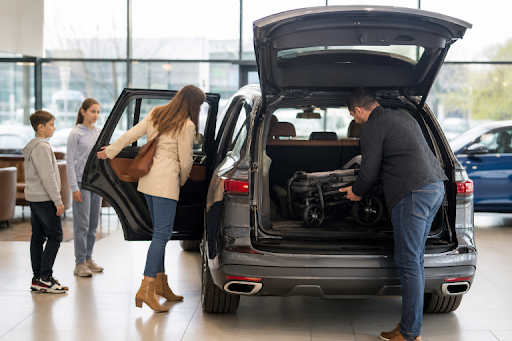
Cargo-volume figures are helpful, but they can feel abstract. Picture the items that actually ride with your family: a stroller, backpacks, soccer bags, a warehouse-store haul, suitcases, or a dog crate. Bring one or two of those items to the dealership if possible.
Check more than the total capacity. Look at the width of the liftgate opening, the height of the cargo floor, the shape of the space, and how easily the rear seats fold. A wide, square opening can be more useful than a larger number on a specification sheet.
5. Pick the Right Powertrain
- Gas: A straightforward option for drivers who take frequent long trips, need quick refueling, or may tow regularly.
- Hybrid: A strong fit for families with steady commuting and stop-and-go driving who want better fuel economy without depending on charging.
- Plug-in hybrid: Best for households that can charge at home and typically drive short enough daily distances to use electric power often.
- Electric: Worth considering when dependable home or workplace charging is available, and road-trip charging plans are comfortable for your family.
Compare annual energy costs, not only miles-per-gallon or range figures. Multiply your expected yearly mileage by likely fuel or electricity costs, then consider how long you expect to keep the vehicle.
6. Review Comfort and Convenience Features
Small details can have a major effect on family life. Look for rear air vents, wide-opening doors, durable upholstery, useful door pockets, cupholders, USB ports, rear climate controls, and a power liftgate. Second-row sliding seats, built-in sunshades, roof rails, and parking cameras may also solve everyday frustrations.
Test the infotainment system before buying. Connect your phone, adjust climate settings, try the camera view, and see whether common controls are easy to reach. Technology is only helpful when it is simple enough to use without distracting the driver.
7. Estimate Full Ownership Costs
A monthly payment is only one part of the budget. Include the purchase price, loan interest, insurance, fuel or charging, maintenance, tires, registration, taxes, and expected resale value. Get insurance quotes for the exact model and trim before signing paperwork, since similar SUVs can have very different premiums.
For example, a model with a lower payment may still cost more each month if it uses significantly more fuel or carries higher insurance rates. Leave room in the budget for routine service and unexpected repairs instead of committing every available dollar to the payment.
8. Use a Smart Test-Drive Checklist
- Bring regular passengers and install the child seats you use.
- Load a stroller, sports bag, or another bulky item.
- Drive on local streets, highways, hills, and parking lots if possible.
- Check outward visibility at intersections and while reversing.
- Listen for wind, tire, and road noise at speed.
- Test third-row access, rear climate controls, and phone connectivity.
A vehicle that feels fine for ten minutes may become tiring after an hour. Pay attention to seat comfort, ride quality, and how calm the cabin feels at highway speeds.
9. Avoid Common Family SUV Buying Mistakes
Do not choose solely by appearance, assume all trims include the same safety equipment, or buy a third row that will go unused. Compare safety information from more than one perspective. The NHTSA 5-Star Safety Ratings allow shoppers to review government crash-test information, including frontal, side, and rollover evaluations.
Also, avoid skipping maintenance research or waiting until after purchase to price insurance. A little advance work can prevent years of avoidable cost and inconvenience.
10. Make the Final Decision
Before committing, confirm that the SUV fits your daily passenger count, child seats, cargo needs, driving routine, and total budget. Verify that required safety features are included on the selected trim, not merely available as an option. If every regular passenger has tried the vehicle and it still feels comfortable, functional, and affordable, you are much closer to the right choice.
The best family SUV is the one that handles real routines with the fewest compromises. Taking time to compare safety, space, comfort, efficiency, and long-term costs can lead to a purchase that continues to feel useful long after the excitement of delivery day has passed.